
 Saturday, June 6, 2026


 Saturday, June 6, 2026


Developed countries should make ‘interim’ vaccine supplies available


By Vishani Ragobeer
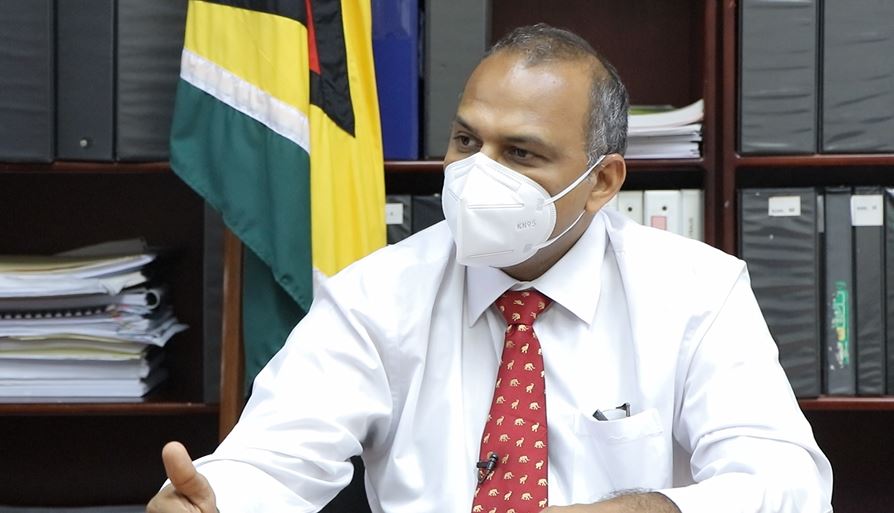
Minister of Health, Dr. Frank Anthony, called upon developed countries to make an interim supply of vaccines available to the Caribbean region, given the state of need countries in the region are in, owing to the disproportionate impact of the COVID-19 pandemic.
While speaking on behalf of the Caribbean Community (CARICOM), at a special meeting convened by the United Nations (UN) Economic and Social Council, Dr. Anthony lamented, “CARICOM remains deeply concerned” about the inequitable access and unbalanced distribution of COVID-19 vaccines globally.”
The Health Minister reasoned that access to vaccines is particularly important for small developing states since these countries continue to experience the devastating health and economic impacts of the COVID-19 pandemic.
In fact, the Minister related that lockdown measures, supply chain disruptions, sharp declines in remittances, and a general decrease in travel, trade, and other economic activities that the region depends on, have all been disrupted by the pandemic.
According to recent reports from the International Monetary Fund (IMF), there will be uneven growth in the real Gross Domestic Product (GDP) across the Latin America and the Caribbean (LAC) region. The Real GDP measures a country’s total economic output, adjusted for price changes. Importantly, the IMF noted that the tourism-dependent countries have been adversely affected due to the restrictions imposed by the pandemic.
Against this backdrop of the disproportionate impact the pandemic has had on Caribbean states, the Minister reiterated the Caribbean’s call for global and equitable access to vaccines stating that this will lessen the impact of the pandemic, protect citizens, and bolster the economy.
“The Caribbean Community uses this opportunity to also reiterate the need for full funding for the Access to COVID-19 Tools Accelerator and its COVAX facility led by the World Health Organization,” the Health Minister stated.
He also appealed for low-cost financing from the international financial institutions (IFIs) so that all developing countries, particularly small states, can contain and suppress the COVID-19 pandemic. He also reiterated the need for enhanced international cooperation and reiterated CARICOM’s calls for a Global Summit to urgently address equitable access to COVID-19 vaccines, particularly for developing countries.
INTERIM SUPPLIES
In this vein, he made a fervent appeal for developing countries to provide vaccines to the region. He said: “We, therefore, urge developed countries, in particular those in our neighbourhood with populations that travel frequently to our region, and who host our largest diaspora populations, to make an interim supply of vaccines available to the Community, given the immediacy of the need.”
Vaccine supplies have not trickled down to developing countries, equitably since many of the larger, developed countries have secured this commodity for themselves. The COVAX facility, a global vaccination alliance, was created with the mandate of ensuring that there is some equity in vaccine distribution. Many Caribbean countries depended upon COVAXfor vaccine supplies but the scarcity of vaccines caused this facility to scale down the distribution of vaccines in the region.
Despite this, Dr. Anthony expressed the region’s gratitude to COVAX and by extension the World Health Organization (WHO), for the commencement of the distribution in the region. He also thanked the bilateral partners which provided much-needed assistance.
“As we begin to look ahead to a post-COVID 19 world we remind all that we must work together, in unity and solidarity, to build back better. We also remain mindful that no one can be safe until everyone is safe,” Dr. Anthony underscored.
GLOBAL CHALLENGES
Meanwhile, Director-General of the WHO Tedros Adhanom Ghebreyesus lamented, “Vaccine equity is the challenge of our time and we are failing.”
Illustrating his point, the Director-General highlighted that of the 832 million vaccine doses administered, 82 per cent have gone to high- or upper‑middle-income countries, while only 0.2 per cent have been sent to their low-income counterparts.
In high‑income countries alone, 1 in 4 people have been vaccinated. Contrastingly, in poorer countries, the average for vaccination is about 1 in every 500 persons.
He also acknowledged that COVAX has not been able to distribute the number of vaccines it had planned to. He related that the facility distributed 40 million doses to 100 countries, but noted that the WHO had expected to have distributed 100 million doses by now. But he said that the challenge has been securing those vaccines.

