
 Sunday, June 7, 2026


 Sunday, June 7, 2026


More than half of Guyanese children taught but learning loss still a concern – World Bank


The COVID-19 pandemic has affected education systems across the Latin America and Caribbean (LAC) region but the World Bank has found that student engagement has been low in Guyana, leading to concerns of learning losses.
More than a year after the onset of the pandemic, a report from the World Bank noted that an average of 86 per cent of children across 24 countries in the LAC region receives some type of education – that is, either face-to-face or virtual.
Worryingly, however, Guyana and Guatemala have the lowest estimated rates of engagement with about 64 per cent of children being able to more readily access learning during the pandemic.
The new report from the World Bank and the United Nations Development Program (UNDP) is named: “An Uneven Recovery: The impact of COVID-19 on Latin America and the Caribbean.”
And based on the data collected through surveys of groups of adults in the 24 countries, the Bank’s report stated that the lower-than-optimal levels of educational engagement suggest “severe learning losses and an increase in drop-out rates.”
Further, the report noted that these learning losses and dropout rates have “grave implications” for the accumulation of human capital in countries.
Previously, Representative of the World Bank Ricardo Habalian estimated that school children in Guyana could lose about one year of learning because of the closure of schools for face-to-face classes prompted by the COVID-19 pandemic. And this, he said, could lead to significant challenges for the children in the future.
Similarly, UNICEF representative Nicolas Pron posited that children could be affected by significant learning losses if they did not return to schools, due to challenges in internet connectivity and accessing online classes.
Pron also reasoned that children were losing valuable social services offered through face-to-face schools such as much-needed socialisation, meals and care for their well-being.
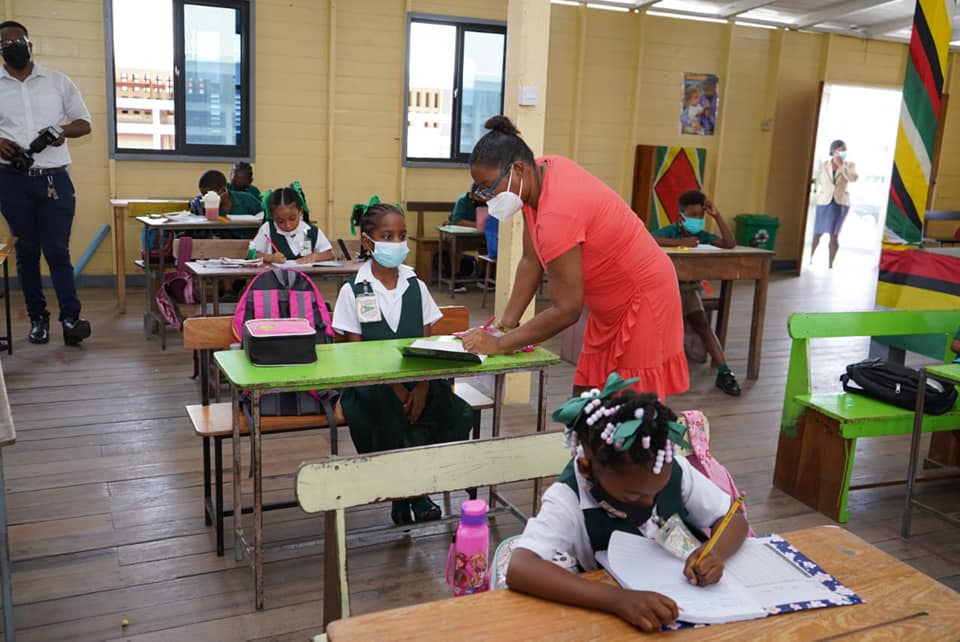
In light of these concerns, the local authorities have been pushing for widespread COVID-19 vaccination to ensure that schools can be reopened for full face-to-face classes. Already, schools have been reopened but are operating on a rotational basis.
Importantly, the World Bank report acknowledged that in-person or face-to-face schooling is more common in the Caribbean and Central America. And, it stated that children from wealthier households were more likely to be engaged during the pandemic, ably adjusted to virtual schooling.
Contrastingly, the report stated, “Those from low socio-economic levels were particularly affected, which suggests long-lasting negative effects on social mobility and inequality.”

