
 Saturday, June 6, 2026


 Saturday, June 6, 2026


Border controversy: Venezuela’s belated objections “legally unsupportable” – Greenidge tells ICJ


Guyana’s legal team will show that Venezuela’s belated objections before the International Court of Justice (ICJ) cannot be supported and that the World Court should proceed with determining the merits of Guyana’s case in the long standing border controversy.
This is according to Carl Greenidge, the Agent of Guyana in the case concerning the Arbitral Award of October 3, 1899, during his remarks before the ICJ in Hague, Netherlands on Friday.
“Guyana will demonstrate today that Venezuela’s preliminary objections are both legally unsupportable and entirely without foundation,” the Guyanese Agent declared before ICJ President Judge Joan E. Donoghue and other judges.
After Greenidge’s remarks, lawyers representing Guyana are expected to present their submissions to the Court.
Greenidge reminded the Court that in December 2020, the ICJ ruled that it has jurisdiction over the case, rejecting Venezuela’s objections in this regard.
Then, on March 8, 2022, Guyana filed its Memorial on the merits of its case against Venezuela in accordance with the Order of 8 March 2021 of the Court.
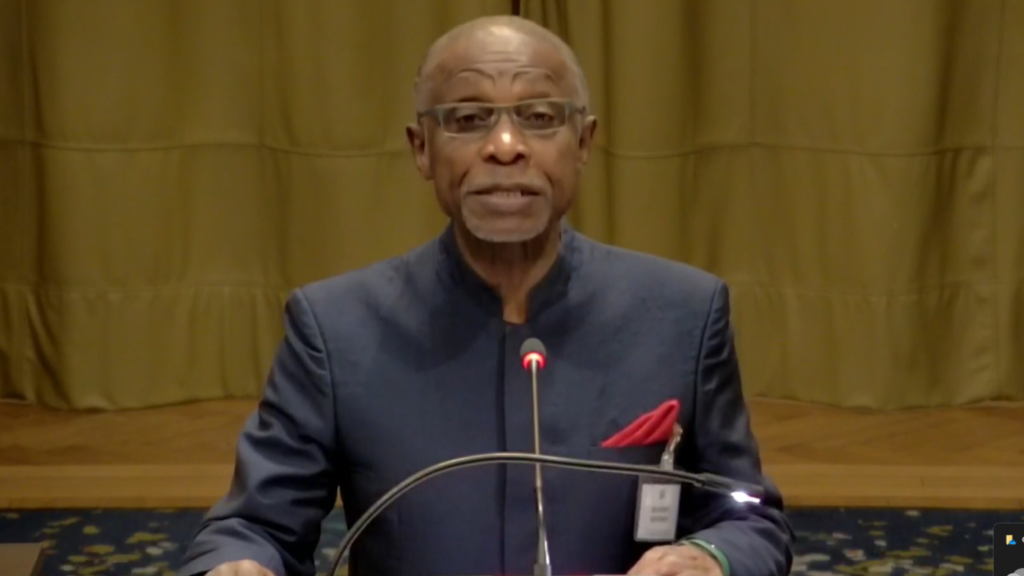
He said Guyana has been complying with requirements from the Court because the country remains committed to international law.
After Guyana filed its Memorial, Greenidge noted that Venezuela filed preliminary objections to the admissibility of Guyana’s Application to the Court to determine the validity of the 1899 Arbitral Award on June 7, 2022.
In accordance with its rules, the Court suspended the proceedings on the merits until the determination by the ICJ as it relates to Venezuela’s preliminary objections.
Greenidge described Venezuela’s preliminary objections as a tactic meant to delay the Court’s assessment of Guyana’s merits in the border controversy. This tactic, he said, is all the more apparent given the Spanish-speaking country’s non-participation in earlier proceedings at the ICJ.
But even so, he posited that Venezuela’s belated engagement with the Court indicates that the country is finally accepting the legitimacy of the Court in settling this controversy.
“…it is apparent that it accepts the legitimacy of the Court’s role, its power to dispense justice and the binding effects of the Court’s orders and judgements,” Greenidge said on Friday.
On Thursday, Venezuela asked the World Court to throw out the case filed by Guyana. It also argued that the United Kingdom should be a party to the border case given that the state was party to the Arbitral Award that determined the land boundary between the two countries; Greenidge said that Guyana’s lawyers will contest this in their submissions.
Instead of an ICJ ruling, Venezuela wants to resolve the border controversy through direct talks with Guyana.
Earlier attempts at those talks, however, failed. As such, the matter was referred to the ICJ by United Nations Secretary General Antonio Guterres.
Guyana is seeking to obtain a final and binding judgment that the 1899 Arbitral Award, which established the location of the land boundary between then British Guiana and Venezuela, remains valid and that the Essequibo region belongs to Guyana and not Venezuela.
Greenidge, on Friday, emphasised the need for this resolution.
“(Venezuela’s claims have) cast a long and menacing shadow over Guyana’s security and development throughout its existence as a sovereign state,” the Guyanese agent lamented.
Guyana is represented in the case before the Court by:
Sir Shridath Ramphal, OE, OCC, KC, Co-Agent and Counsel
Mr. Paul S. Reichler, Attorney-at-Law, Foley Hoag LLP, member of the Bars of the United States Supreme Court and the District of Columbia;
Mr. Alain Pellet, Professor Emeritus of the University Paris Nanterre, former Chairman of the International Law Commission, member of the Institut de droit international
Professor Philippe Sands KC, Professor of International Law at University College London, 11 King’s Bench Walk, London;
Mr. Payam Akhavan, LLM, SJD (Harvard University), Professor of International Law, Senior Fellow, Massey College, University, of Toronto, member of the Bar of New York and the Law Society of Ontario, member of the Permanent Court of Arbitration
Professor Pierre d’Argent, Professor ordinaire, Université Catholique de Louvain, member of the Institut de Droit International, Foley Hoag LLP, member of the Bar of Brussels;
Ms. Christina L. Beharry, Foley Hoag LLP, member of the Bars of the District of Columbia, the State of New York, England and Wales, and the Law Society of Ontario;
Mr. Edward Craven, Barrister, Matrix Chambers, London;
Mr. Juan Pablo Hugues Arthur, Foley Hoag LLP, member of the Bar of the State of New York;
Ms. Isabella F. Uria, Attorney –at-Law, Foley Hoag LLP, member of the Bar of the District of Columbia.

