
 Saturday, June 6, 2026


 Saturday, June 6, 2026


Border controversy: Attorney General asks union of 180 parliaments to condemn Venezuela
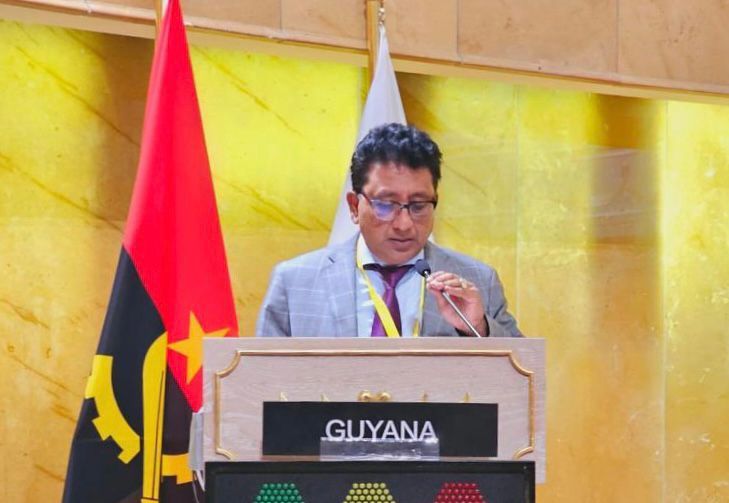


Attorney General Anil Nandlall has asked a union of parliaments, representing 180 countries, to condemn Venezuela’s continued claim to Guyana’s territory and to respect the legal process to determine its claim that the arbitral award of October 1899, which determined the boundaries of the two countries, is null and void.
Nandlall is in Luanda, Angola for the 147th meeting of the Inter-Parliamentary Union (IPU), one of the oldest and largest association of Parliaments in the world.
Venezuela has scheduled a referendum for December 3, 2023. Its goal is to annex more than two thirds of Guyana’s sovereign territory.
“This reckless and unlawful move is intended to further Venezuela’s baseless claim to Guyana’s territory – a dispute long settled by Arbitration in 1899.
“Venezuela perseveres with this illegal conduct despite that this issue is pending between the two States at the International Court of Justice upon the direction of the UN Secretary General,” Nandlall stated.
He added: “Actions like these not only undermine public institutions but engender conflicts and violate the very thematic fundamentals of this conference. In the circumstances I call upon the IPU to condemn the actions of the Republic of Venezuela and demand that Venezuela respect the legal process of the International Court of Justice. Time is of the essence!”
In the arbitral tribunal award of October 3rd, 1989, the borders of Guyana (then British Guiana) and Venezuela was settled, with Venezuela inheriting 13,000 square kilometers of what was then British Guiana territory – an area bigger than Jamaica or Lebanon.
Venezuela was bound under international law to respect that award, which it did for the subsequent six decades. Venezuela, however, at the onset of Guyana’s independence in 1966, resorted to various strategies and challenged the award.
There has been a series of acts of aggression by Presidents of Venezuela against Guyana, starting with a Presidential decree of June 1968 to the time of President Nicolás Maduro Moro’s decree of May 26, 2015, which sought to extend Venezuela’s land claim to also annex the country’s maritime space.
In 2013, Venezuelans sent a naval ship into Guyanese waters and seized a U.S.-chartered oil survey ship and escorted it to Margarita Island. In the same year, a Canadian-based mining company Guyana Goldfields said it had received an notification of possible legal action by Venezuela over its operations in Guyana.
In September 2015, Guyanese authorities also said the Venezuela army was up the Cuyuni River, in the northwest of the country which borders Venezuela.
An agreement reached in Geneva on February 17, 1966, allowed for the United Nations Secretary General to determine a resolution to the controversy and dialogue and talks ensued for decades.
In mid-February 2017, the new UN Secretary-General António Guterres appointed Dag Halvor Nylander of Norway as his Personal Representative on the Border Controversy, in a final effort at dialogue to settle the matter. That failed.
On January 31, 2018, the UN Secretary General referred the matter to the ICJ and Guyana filed it case.
The first step was to establish jurisdiction, whether the court can rule on the case and it did so on April 6 this year. While boycotting much of the procedure, Venezuela tried to stop the case from moving forward by arguing the United Kingdom should be involved as Guyana was a British colony in 1899, but judges rejected that reasoning and said they have jurisdiction.
The court “by 14 votes to 1, rejects the preliminary objection raised by the Bolivarian Republic of Venezuela,” said presiding judge Joan Donoghue, while reading the decision.

