Site logo
Calendar IconFriday, June 5, 2026
  • Home
  • All News
  • Crime & Security
  • Politics
  • Sports
  • Oil & Gas
  • Business
  • Education
  • MORE
    • Health
    • Agriculture
    • Entertainment
    • Regional
    • Features
    • Letters
    • Advertise
    • Trending
    • Video
  • facebook-black
  • instgram-black
  • tiktok-black
  • twitter-black
  • youtube-black
  • Home
  • Advertise
  • Get The App
  • Contact Us
Categories
  • All News
  • Sports
  • Crime & Security
  • Politics
  • Oil & Gas
  • Business
  • Education
  • Health
  • Agriculture
  • Regional
  • Features
  • Letters
  • Top Stories
  • Social
  • Classifieds
  • Culture
  • Entertainment
  • Environment
  • International
  • Top Story
  • Video
  • facebook-black
  • instgram-black
  • tiktok-black
  • twitter-black
  • youtube-black
Search Icon
Calendar IconFriday, June 5, 2026
  • facebook-black
  • instgram-black
  • tiktok-black
  • twitter-black
  • youtube-black
  • HomeHome
  • TrendingTrending
  • VideoVideo
  • ContactContact Us
  • Home
  • Environment
  • To make progress on deforestation at COP30, countries must be paid to keep forests standing
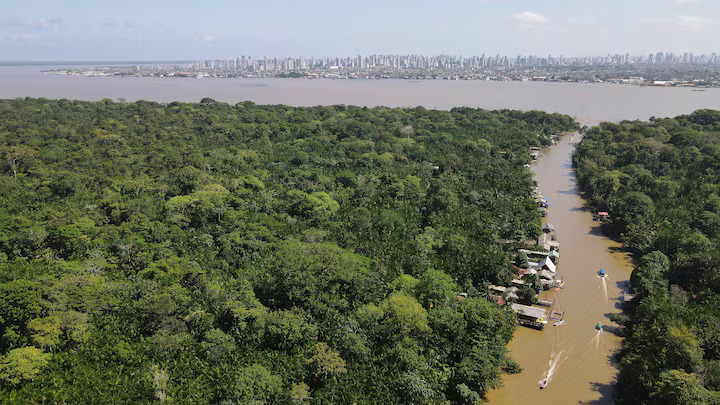
    To make progress on deforestation at COP30, countries must be paid to keep forests standing

    Environment
    Features
    Politics
    November 17, 2025
    To make progress on deforestation at COP30, countries must be paid to keep forests standing
    To make progress on deforestation at COP30, countries must be paid to keep forests standing
    FacebookTwitterPinterestEmailPrintWhatsAppRedditTelegramLinkedIn
    HandInHand-Top_Article-728x90

    By Dr Mohamed Irfaan Ali

    President of the Co-operative Republic of Guyana

    Nov 17 (Reuters) – More than 30 years after the world first came together in Brazil to tackle climate change, global temperatures are still rising and so is impatience with talk over action.

    Citizens everywhere are asking a fair question: where is the progress?

    People want proof that climate action works: that investing in nature creates jobs, strengthens economies and makes communities safer.

    At COP30, the question we’re being asked is clear: how can we turn promises into progress?

    When it comes to forests, there’s finally a story of real momentum.

    For decades, protecting forests felt like an uphill struggle. Now, that’s changing. Forest nations and partners around the world are rewriting the economics of conservation, turning forest stewardship into an engine of prosperity and sustainable growth.

    In Guyana, our pioneering system for high-integrity carbon credits has shown how trees can be worth more standing than cut down.

    Brazil’s leadership on the new Tropical Forests Forever Facility (TFFF) is creating a predictable, long-term finance reward for countries to preserve their forests and direct proceeds to Indigenous Peoples and local communities. Across the world, investors are beginning to recognise that keeping forests standing is not just good for the planet, it’s good for their bottom line.
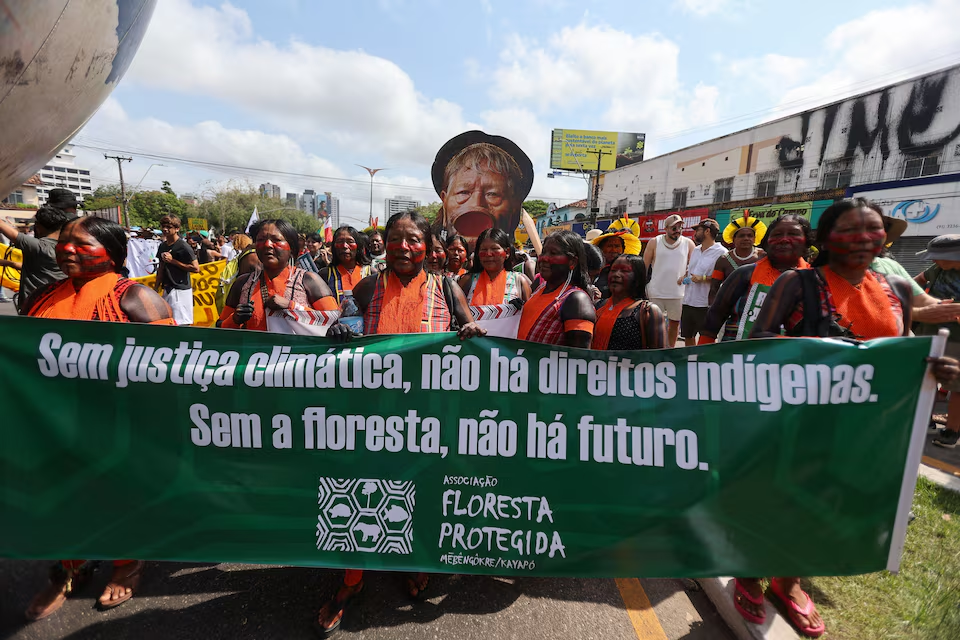
    Demonstrators hold a banner that reads “Without climate justice, there are no indigenous rights. Without the forest, there is no future” during a protest to call for climate justice and territorial protection during the U.N. Climate Change Conference (COP30), in Belem, Brazil, November 15, 2025. REUTERS/Anderson Coelho


    Still, we must go further.

    There is no global stability, and no solution to the climate and nature crises, without healthy, thriving forests. Forests absorb nearly one-third of global carbon emissions and sustain four-fifths of life on land, but they receive less than 1% of global climate finance. Preserving tropical forests would cost about $66.8 billion a year – less than the world spends on ice cream – while delivering 20% of the most cost-effective climate solutions available.

    Protecting forests requires global collective effort. Far too often, forest-rich countries have shouldered the burden alone, only to be let down by a lack of global support. Countries like Guyana protect global assets that benefit everyone, but the financial support long pledged by the world’s wealthy nations has failed to flow.

    To address this imbalance and close the forest finance gap, the Forest & Climate Leaders’ Partnership (FCLP), which I have the honour to co-chair alongside the UK government, has worked with Brazil and the United Nations Environment Programme (UNEP) to develop the Forest Finance Roadmap: a practical plan to close the forest finance gap by 2030 and build a global economy that rewards preservation rather than destruction.

    The roadmap identifies six ways to make it pay to keep forests standing.

    These include expanding high-integrity carbon markets to unlock up to $6 billion a year for forest nations, fully funding the TFFF to reward the value of standing forests, and accelerating investment in the forest bioeconomy to mobilise a further $15 billion a year while creating green jobs. The roadmap also identifies the opportunities from aligning corporate supply chains with forest goals, managing sovereign debt to service payments to free up $5 billion annually for forests, and reforming agricultural subsidies.

    These solutions are already working and growing in momentum.
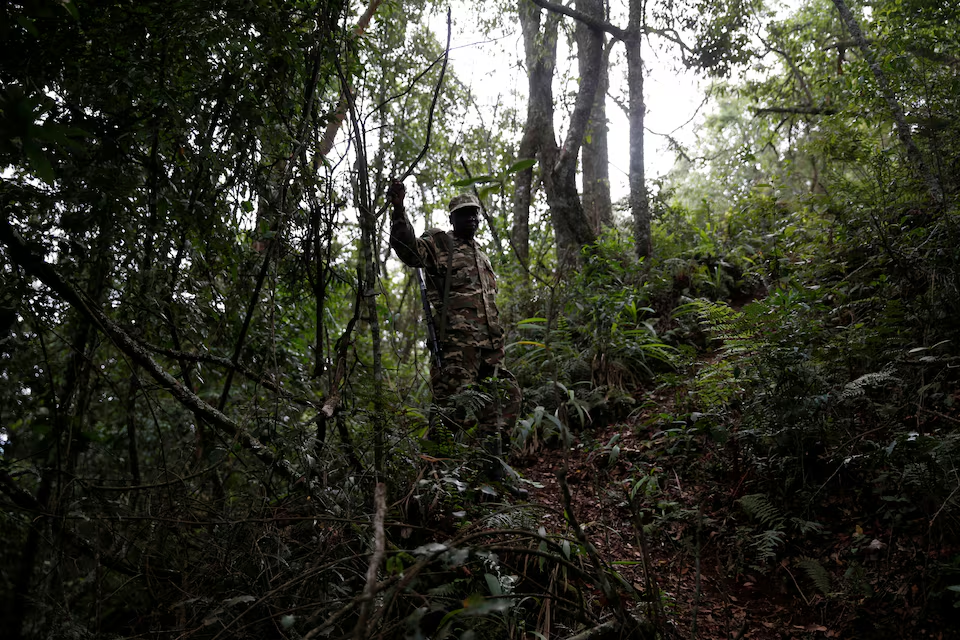
    A wildlife ranger stands inside the forest within the Bwindi National Park near the town of Kisoro, Uganda. REUTERS/Baz Ratner
    Guyana has demonstrated how revenues generated from carbon credits can be channelled directly into local communities. These funds have supported thousands of community-led projects, resulting in the construction of schools and roads, and fostering sustainable livelihoods that benefit residents whilst maintaining the integrity of forest ecosystems.
    The Brazil Restoration and Bioeconomy Finance Coalition (BRB Finance Coalition) has made a significant commitment to the country’s environmental future. The coalition has pledged to mobilise a total of $4.5 billion for forest restoration and bioeconomy initiatives nationwide, supporting the development of green industries and the restoration of vital forest landscapes.
    Meanwhile, Ecuador’s innovative approach to nature finance has set a new precedent. Through its landmark debt conversion, the country unlocked approximately $460 million for nature conservation. This funding has been dedicated to safeguarding the Amazon through the Amazon Biocorridor Program (Programa Biocorredor Amazónico), enabling the protection of critical habitats and advancing sustainable development goals.
    Across the world, governments and businesses alike are proving that partnership between the Global South and Global North works. With new members such as Paraguay, Cambodia, Switzerland, Papua New Guinea, and Belize, the FCLP is growing stronger and gaining momentum – a living example of how partnership can replace paralysis.
    So when people ask, “What’s changed since 1992?” the answer is this: a turning point is finally within reach. After more than 15 years of groundwork, the outlines of a new global forest economy are emerging – one that rewards forest preservation and supports economic development.
    We stand on the cusp of genuine transformation. If we act together, and act boldly, this can be the decade when the world truly made it pay to keep forests standing while protecting jobs, communities, biodiversity and the climate itself.
    At COP30 in Belem, our task is clear. We must push further, move faster and work together to ensure that by 2030 the world can look back and say: this was the moment we turned promises into progress.

    Related Articles

    Sidebar – Top Ad

    Recent Posts

    Sidebar – Bottom Ad
    JUNE 2026
    MON
    TUE
    WED
    THU
    FRI
    SAT
    SUN
    1
    2
    3
    4
    5
    6
    7
    8
    9
    10
    11
    12
    13
    14
    15
    16
    17
    18
    19
    20
    21
    22
    23
    24
    25
    26
    27
    28
    29
    30

    Subscribe to News Room for email updates on the latest posts.

    By subscribing, you accepted Our Policy

    Site logo

    News Room is a news outlet launched in 2016 and caters to persons interested in creative and intelligent journalism with a broad perspective. We are a daily news broadcast on E-Networks channel, E1, and our stories are also distributed via the devices closest at hand: mobile phones and tablets.

    Quick links

    • Home
    • All News
    • Crime & Security
    • Politics
    • Health
    • Letters
    • Sports
    • Oil & Gas
    • Business
    • Education
    • Agriculture
    • Features
    • Entertainment
    • Regional
    • Advertise
    • Get The App
    • Contact Us
    • Trending

    © 2026 Copyrights by News Room. All Rights Reserved.

    • facebook-black
    • instgram-black
    • tiktok-black
    • twitter-black
    • youtube-black
    • Privacy Policy
    • Term & Conditions